

TLDR
- Global privacy debates and AI-data concerns pushed confidentiality narratives back into the spotlight.
- ZEC (+73.97%) and XMR (+23.63%) surged - and COTI joined the wave (+68.63% weekly, +49.09% daily).
- COTI isn't a privacy coin but a programmable privacy Layer 2 powered by garbled circuits
- Influencers like Ash Crypto, Carl Moon, and Crypto Banter amplified the narrative and talking about COTI
- Institutions prefer COTI because it enables private computation with compliance and programmability.
- COTI's long-term pillars: CBDC pilots, Privacy-on-Demand across chains, private AI, RWAs, PPML, DyDID, and multichain privacy
- COTI surged because traders recognized it as the next phase of the privacy trend - not a competitor to privacy coins but the evolution of the concept.
Privacy is having a moment again. Across 2025, global debates around surveillance, AI data harvesting, and encrypted communications pushed privacy technologies back into the spotlight. Governments are proposing new monitoring frameworks, regulators are tightening rules on self-custody, and Big Tech continues to train AI models using massive datasets - often without meaningful user consent. In crypto, this tension is showing up in market behavior.
And the numbers are clear. According to CoinMarketCap, the past week saw a sharp surge in assets tied to the privacy discussion: Zcash jumped 73.97%, Monero climbed 23.63%, and another unexpected asset joined the breakout. COTI - not a privacy coin, but a programmable-privacy Layer 2 - rallied 68.63% over the past seven days and 49.09% in the last 24 hours, trading at $0.063 at the time of writing.
COTI's rally didn't happen in isolation. It was part of a broader shift in how traders interpret privacy - no longer as purely anonymity, but as controlled confidentiality. And this shift is one of the reasons COTI is being noticed alongside old-guard privacy coins, even though its architecture and purpose are entirely different.
Let's dive deeper into what's going on behind the scenes.
Market Attention Turns to COTI
For years, privacy narratives were dominated by familiar names - Monero, Zcash, Dash. Their goals were aligned: hide who transacts with whom, conceal amounts, and provide immunity from surveillance. But the industry evolved. Regulators tightened oversight. Institutions stepped into crypto. AI models began ingesting everything. The world didn't just need secrecy - it needed programmable control.
This is where COTI enters the conversation. While Zcash and Monero focus on hiding transaction details, COTI's programmable privacy focuses on where, how, and when information becomes visible - not on removing visibility outright. That distinction matters. It makes COTI compatible with DeFi, AI agents, banks, and even CBDC pilots.
And it explains why a programmable-privacy network surged alongside assets traditionally categorized as privacy coins. Something deeper is happening. Traders are starting to connect the dots.
What's Fueling COTI's Rapid Growth?
The recent surge wasn't a random pump. It aligns with three forces:
- A market-wide privacy renaissance
- A growing influencer spotlight
- COTI's technical leadership becoming more visible
And at the center of all of it is a shift in how the industry understands privacy itself.
1. Technology Narrative: The Shift to Programmable Privacy
COTI's CEO, Shahaf Bar-Geffen, has been unusually active on X - and several posts sparked strong engagement. Not because of hype, but because they explain a shift that many in the market hadn't seen clearly until now.
Here's one of the tweets that went viral:
This tweet reframed the privacy debate. Instead of "privacy coins vs. the world," it framed privacy as an evolution - and placed COTI at the newest stage. That captured attention among traders, builders, and analysts.
Another widely circulated post explains :
This resonated with developers - privacy without changing how they build. Combined with the market-wide privacy narrative, COTI suddenly became a natural fit for the trend, even though it isn't a privacy coin.
2. Influencers Step Into COTI's Umbrella
Major influencers have begun highlighting COTI - not as a meme, but as part of the programmable privacy trend.
Ash Crypto (2M followers), He tweeted:
He later added that COTI is fast, programmable, and compliant - and that's the missing piece for mass adoption.
Carl Moon, Another large account shared:

COTI offers programmable privacy, which puts it far ahead of traditional privacy coins like Zcash or Monero. Carl Moon’s tweet alone has generated massive curiosity.
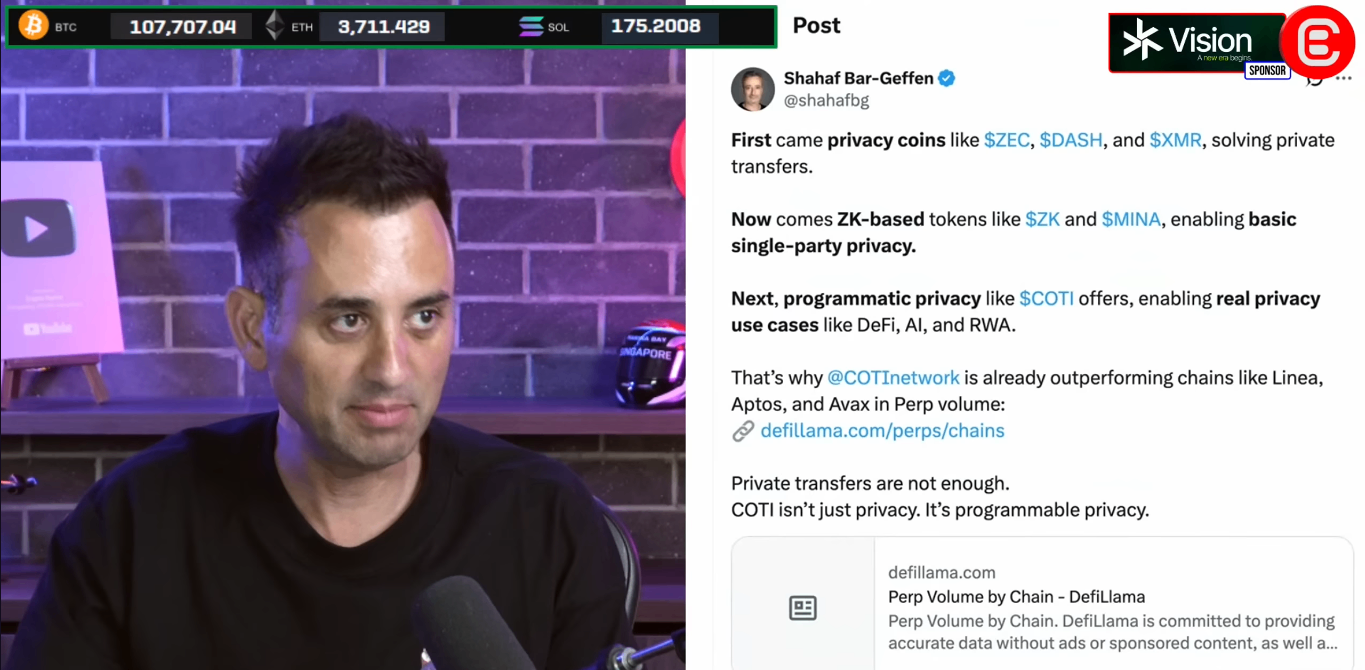
Anothet big influencer and youtuber “Crypto Banter “(1.18M subscribers)
At around 43:26 in a recent video, Crypto Banter discussed COTI as a core part of the emerging privacy narrative - marking one of the first mainstream YouTube mentions in this trend.
All of this compounding attention is part of the surge.
3. Strong Foundation and Long-Term Vision
COTI isn't reacting to the privacy moment - it's been building toward it for years.
Its roadmap spans:
- Multichain privacy
- DeFi privacy infrastructure
- Privacy-preserving machine learning
- RWA tokenization with confidentiality
- CBDC pilots
- Selective disclosure and compliance tools
- Private AI computation via garbled circuits
COTI's BD Lead, Prince Pratap, summarized this vision:
This reinforces that COTI's rise is not a short-term reaction - it's traction built on years of technical groundwork.
Why Banks, Enterprises & Institutions See COTI Differently Than Zcash
The surge in interest around privacy has forced institutions to look beyond anonymity and toward infrastructure that can coexist with regulation, compliance, and large-scale financial systems. That's where the distinction between Zcash and COTI becomes clear.
Zcash delivers strong default privacy at the transaction layer. It's built for users who want anonymity and fungibility, and its shielded-pool design reflects that mission. But the same design that makes ZEC appealing for personal privacy also limits how it fits into regulated environments. It doesn't support programmable logic, can't embed compliance rules, and can't offer selective visibility - which is essential for banks, fintech platforms, and government-linked projects. Institutions need privacy, but they also need auditing, token-level controls, and integration with existing financial infrastructure. Zcash isn't built for that world.
COTI, on the other hand, is built specifically for it. Its programmable-privacy framework - powered by garbled circuits - allows confidentiality without removing control. Banks can implement privacy while still maintaining compliance pathways, assign permissions, embed policy logic, and reveal data only when needed. That balance between privacy and oversight is exactly what regulated entities require. And this isn't theoretical: COTI has already worked with the Bank of Israel on the Digital Shekel pilot, and it is actively collaborating with the European Central Bank (ECB) as a Pioneer Partner developing privacy-preserving mechanics for the Digital Euro. When two major central banks choose to evaluate the same privacy system, it signals institutional alignment, not experimentation.
Enterprises see COTI as a privacy layer that can scale across payments, CBDCs, RWAs, DeFi, and AI computation - without breaking compliance. Governments see it as a path to regulated confidentiality rather than anonymity. And traditional financial institutions see it as a way to bring private logic into digital assets without compromising on their regulatory requirements.
That's why, in institutional circles, COTI isn't grouped with privacy coins. It's grouped with emerging financial infrastructure.
What Happens Next?
COTI's move to $0.063 didn't come from hype alone. It came from structural shifts in how crypto thinks about privacy. The programmable privacy narrative is early, but the attention is growing fast.
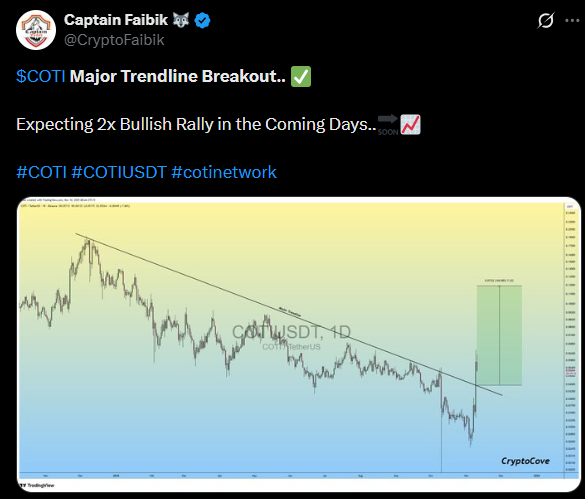
Well-known trader Crypto Faikik shared his analysis on X, predicting that COTI could reach $0.12.
Builders see COTI as the first practical path to confidential smart contracts. Traders see it as an emerging narrative. Influencers see it as the next evolution of privacy. Enterprises see it as a compliant confidentiality layer. And institutions see it as infrastructure, not a coin. Combined, that creates a foundation for more participation - not just speculative but developmental.
The privacy surge may have started with Zcash and Monero, but COTI entered the conversation because it represents something new entirely.
READ MORE: Defis Privacy-crisis: How Coti Could be the answer to a $1 billion problem