


TL;DR
- Cocoon, Telegram's decentralized confidential compute network, is now live and already processing real AI requests.
- GPU owners can earn TON by powering the network, while users get 100% private AI responses.
- Developers plug into cheaper, privacy-protected AI compute without relying on centralized providers like AWS or Azure.
- Community reaction has been strong, with concerns about GPU shortages and praise for Cocoon's privacy-first model.
- More GPU supply, developer onboarding, and Telegram-native AI features are coming next.
The AI world has been pushing toward more centralized compute - huge server farms run by a few dominant providers. This setup makes AI development expensive, limits competition, and exposes user data to the companies running the servers. Telegram's new move flips that dynamic. Cocoon, a decentralized confidential compute network, just went live, opening the door for cheaper and private AI at scale.
Dhruv, who has been leading communication around the launch, summed it up clearly in his announcement:
Once this post went out, it triggered an immediate wave of interest across Telegram communities, TON users, and broader crypto AI circles. People have been waiting for a privacy-first AI system that actually runs on-chain and works at scale. Cocoon finally gives them that.
Why Cocoon Matters Now
Dhruv didn't mince words about the limitations of current AI infrastructure:
This statement hits on two real pain points:
- Price - centralized companies control supply, keeping costs high.
- Privacy - the same companies must see your data to process your requests.
Cocoon removes both of those issues. Instead of relying on one massive corporation, Cocoon spreads the workload across many GPU owners around the world. Those providers earn TON for processing model requests, forming an open, privacy-preserving compute market.
That shift matters because AI demand is growing faster than GPU supply. Even NVIDIA, the backbone of the entire AI boom, is tightening the availability of key components. Someone from the community captured it perfectly in one of the early reactions:
Dhruv responded with the underlying philosophy behind Cocoon:
That's Cocoon in one sentence: a free-market, confidential, on-demand AI compute layer.
How Cocoon Works (In Simple Terms)
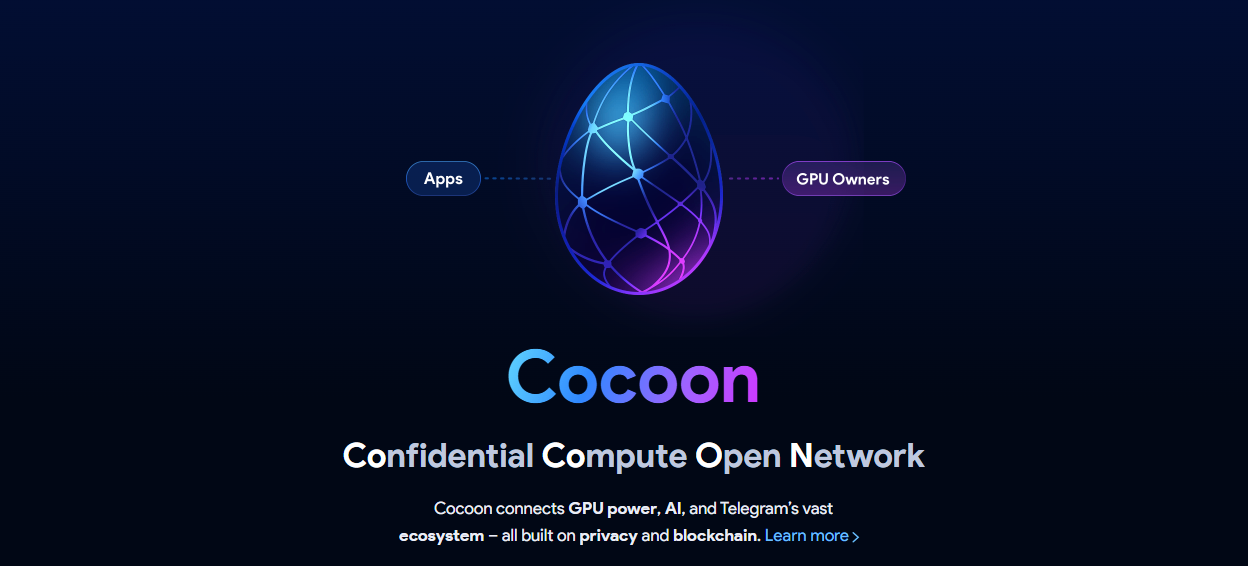
Source: Cocoon website
Cocoon's system is built to be simple for users but extremely secure under the hood. Here's the high-level flow in everyday language:
GPU Providers
Anyone with suitable GPU hardware can connect their server to Cocoon. Once verified, these machines become part of a confidential compute layer. They process AI model requests and earn TON automatically.
Developers
App builders plug into Cocoon to access cheap, private AI compute. Instead of dealing with AWS or Azure contracts, they interact with an on-chain marketplace.
Users
Telegram users (and eventually others) simply interact with AI features - translation, generation, classification - and Cocoon ensures everything stays private.
The project breaks it down clearly:
- GPU owners mine TON by powering the network
- App developers plug into low-cost AI compute
- Users enjoy AI with full privacy and confidentiality
- Telegram fuels demand and hype for Cocoon
Every part of this system works together: compute supply → developer demand → user-facing features → TON settlement.
A Look at Cocoon's Architecture
A Confidential Compute Layer for Everyone. Cocoon describes itself as a "decentralized AI inference platform" - but at its core, it's a simple connector.
It matches GPU owners who want to earn money with developers who need to run models privately. Everything happens inside trusted execution environments (TEEs), which ensure that the inputs and outputs of AI requests remain confidential.
The architecture ensures four things:
- Anyone with a GPU server can earn - creating a free-market supply of compute
- Requests stay private - only the client sees their own inputs and outputs
- Valid responses - clients can confirm the response came from the requested model
- Payments are on-chain - transparent and fast settlement through TON
This isn't a centralized cloud. It's a decentralized compute layer that Telegram can tap directly.
Telegram's Role : Fueling the First Wave of Adoption
Telegram integrating Cocoon wasn't just a small update - it immediately pushed thousands of users into the system. Dhruv hinted that the rollout has already started:

This means the network is not theoretical. It's doing real work today. And because Telegram has over 900 million users, demand will naturally scale as more AI features roll out. Dhruv outlined the next steps:
This sets the tone for the next phase: rapid onboarding, more developer integrations, and more Telegram-native AI experiences.
Community Reactions
A Mix of Excitement and Strategic Insight. The launch created a lot of discussion. A user asked a question that summed up the broader privacy debate:
It's a fair comparison - Zcash is a privacy-focused coin but Cocoon is fundamentally different. It's not a privacy coin. It's a privacy computation layer. Another comment that stood out came from a very privacy-aware part of the community:
These reactions signal that Cocoon didn't just launch well - it launched into a market that was already worried about compute shortages and privacy breaches.
Why This Launch Feels Meaningful
Cocoon isn't positioning itself as a competitor to ChatGPT or big AI companies. Instead, it solves one key layer of the AI stack: where models run.
And by doing it on-chain with privacy guarantees, it creates a category that hasn't existed before. The combination of Telegram distribution + TON payments + decentralized GPUs + TEE privacy forms a model that traditional cloud providers can't replicate.
This gives Cocoon a unique foundation:
- Scales with GPU demand
- Protects user data completely
- Allows developers to verify compute results
- Connects directly into Telegram's ecosystem
Put simply: Cocoon brings the "AI compute" layer into the crypto world in a way that actually works for everyday users.
Looking Ahead
The Next 6-12 Months Will Define Cocoon's Trajectory. Cocoon is still early, but the direction is clear. More GPU supply will join. More developers will plug in. More Telegram features will rely on it. If the network maintains stability and cost efficiency, Cocoon could become one of the most used decentralized compute layers in the world simply because Telegram is its first customer.
And given the pace at which AI demand is rising - and the growing concerns about centralized AI providers - Cocoon's timing might end up being perfect.
Final Thoughts
Cocoon's launch isn't just another crypto project going live. It represents a deeper shift: a move toward AI that respects privacy, lowers cost, and removes centralized intermediaries. It brings compute back to users and lets GPU owners participate in the AI economy directly.
Whether Cocoon becomes a major layer in the broader AI market will depend on adoption and execution. But the foundation is strong, the early demand is real, and Telegram gives it a distribution channel most networks can only dream of.
Cocoon is now live - and the race for confidential AI compute has officially begun.


