TL;DR
- Midnight uses a dual-token model: NIGHT for network settlement and governance, DUST for executing private transactions and smart contracts.
- NIGHT holders generate DUST, a renewable, shielded resource, allowing private operations without spending NIGHT directly.
- DUST is non-transferable, decays if unused, and ensures fair network usage while protecting transaction metadata.
- The system separates value transfer from execution, improving privacy, predictability, and developer flexibility.
- NIGHT distribution is community-focused via Glacier Drop, with block rewards securing the network and incentivizing participation.
- Together, NIGHT and DUST create a privacy-first, user-friendly, and developer-ready tokenomics framework for real-world Web3 adoption.
Midnight sits in a part of Web3 where privacy and usability meet, and the way its token system works reflects that balance. NIGHT and DUST aren't just two assets with different names. They represent two layers of the network that need to operate together: the settlement layer that records value, and the execution layer that powers private logic. Most chains try to make one token do everything, but that usually forces privacy features to compete with basic transaction fees. Midnight avoids that problem by giving each role a clean boundary.
Understanding how these tokens fit into the network matters because Midnight isn't designed as another high-throughput chain or a speculative playground. It's built for applications that need confidentiality, controlled disclosure, and more predictable economics. Those requirements shape the incentives, the circulation model, and the way developers integrate the network into wallets and dApps.
This article breaks down both tokens, how they interact, and why Midnight chose this structure. You'll also see how they appear in real dApps, how fees flow through the system, and how developers can reason about cost and security without relying on assumptions or marketing language.
What NIGHT Represents in the Midnight ecosystem
NIGHT is the settlement asset of the network. That means it handles value transfer, staking, and the economic foundation that supports network security. On most blockchains, the main token needs to absorb every function-settlement, governance, gas, collateral, and whatever else the ecosystem invents. Midnight doesn't take that path. NIGHT keeps its role simple: represent value that can move across the network without exposing confidential data.
The idea here is straightforward. A settlement asset needs to be predictable. If the token is constantly shaped by the fluctuations of execution demand, it becomes harder for developers to plan fee structures and for users to understand what they're paying. By keeping NIGHT focused on economic settlement, Midnight reduces noise and gives users a stable mental model.
Another reason NIGHT stays in its lane is privacy. Midnight supports shielded value transfers where metadata stays protected. Value can move, rules can be enforced, and identity can remain within the user's control. NIGHT gives the ecosystem a clean asset for this type of interaction, whether the transfer is public, private, or selectively disclosed depending on the user's needs.
Where NIGHT shows up in real usage
When users move value on Midnight-whether publicly or inside a shielded circuit-NIGHT is the asset that represents that transfer. This covers simple payments, cross-contract transfers, escrow-style flows, and the kinds of confidential business logic developers often mention when talking about why privacy matters.
Some applications may also rely on NIGHT for collateral inside smart contracts. Because it's the primary settlement asset, it's the one most developers will choose when they need stable accounting or predictable economic references. In multi-party workflows, where one user needs proof of a completed action without revealing underlying details, NIGHT plays the role of the asset being exchanged or temporarily locked.
In broader architecture, NIGHT is also the asset linked to the base layer's long-term security. While the specifics can evolve as the network matures, the pattern is familiar: the settlement token anchors the ledger, while the execution token (DUST) powers the privacy machinery that makes Midnight different from typical chains.
Why DUST Exists as a Separate Token
The existence of DUST can feel unusual at first. Many chains rely on one token for fees, so splitting the execution layer into its own asset may look like extra complexity. But in Midnight's model, that separation removes friction. DUST focuses entirely on execution: it pays for contract calls, ZK proof verification, and the private logic that runs inside circuits.
The advantage becomes clear when thinking about how privacy works. Zero-knowledge proofs aren't free. They require computation, verification, and on-chain commitments. If those costs were tied to the settlement token, every fluctuation in private execution demand would distort the value layer. Midnight prevents that by giving DUST its own supply and dynamics, separate from NIGHT's role.
There's also a practical side for builders. Developers want predictable execution fees, especially when dealing with ZK-enabled applications. DUST gives them a more stable reference point. It's easier to design business logic, estimate user costs, and manage performance when execution has its own framework. This becomes even more important as complex dApps and enterprise-grade workflows begin to appear.
How DUST powers smart contract execution
Whenever someone interacts with a contract on Midnight-creating a circuit commitment, verifying a proof, or triggering confidential logic-DUST is the asset used to pay for that execution. This creates a clean separation: NIGHT moves value, DUST fuels computation.
Smart contracts on Midnight run in a way that protects user data and identity. Instead of exposing the internals of a transaction, contracts rely on zero-knowledge circuits to prove correctness. DUST handles the cost of generating and verifying those proofs, allowing developers to build privacy-first logic without forcing users to give up usability.
Because DUST backs execution, the network can fine-tune performance without interfering with NIGHT's economic role. As Midnight evolves, new ZK optimizations, proof systems, or execution improvements can adjust DUST's cost structure independently. This level of modularity is uncommon and gives the network flexibility as technology changes.
Why the dual-token model improves privacy-preserving design
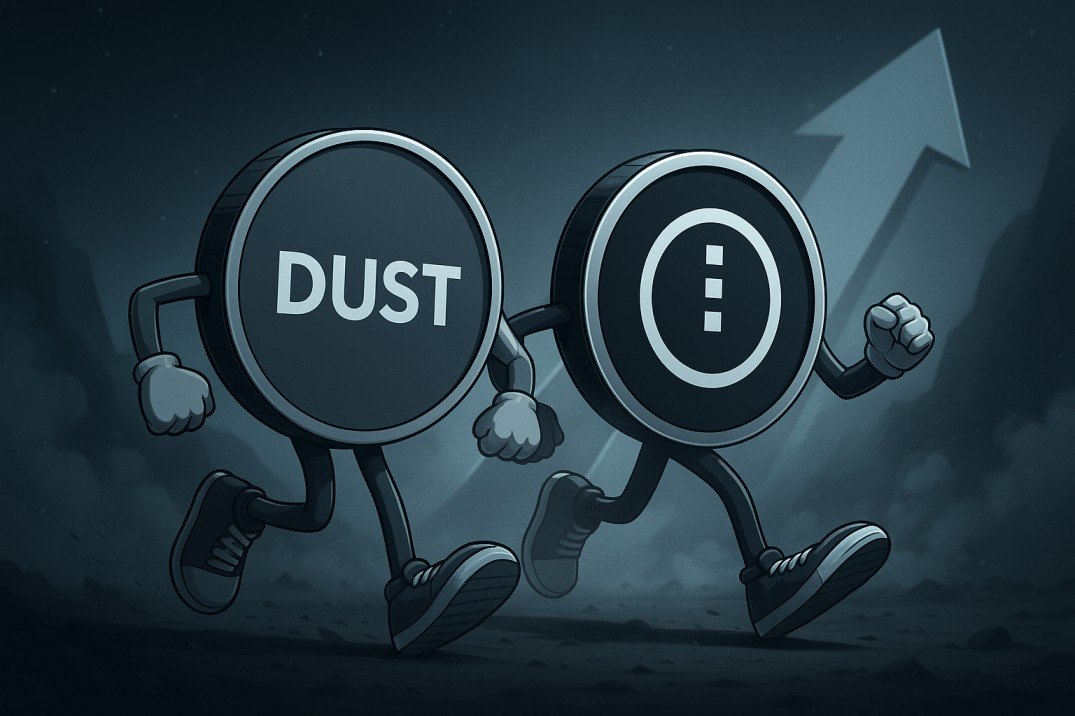
Midnight was built for applications where confidentiality isn't a luxury-it's a requirement. That includes selective disclosure, private state transitions, audit-ready workflows, and interactions where users choose what to reveal and what to keep private. A single-token model complicates this because settlement and execution become tightly coupled, making cost estimation difficult and creating unpredictable effects on both layers.
By splitting NIGHT and DUST, the network keeps each layer focused. NIGHT handles value. DUST handles operations. These roles don't overlap or fight each other, which is especially important for privacy systems where execution costs can vary significantly based on the complexity of zero-knowledge circuits.
This structure also helps developers who want to build applications that mix public and private state. Execution can scale, costs can adapt, and users can choose privacy levels without worrying about economic distortions. The token model becomes a foundation that supports Midnight's broader goal: protecting data and identity while keeping developers productive.
How the tokens interact during real workflows
In a typical Midnight interaction, a user might trigger a private contract call using DUST and then finalize a settlement using NIGHT. The two tokens move through different layers of the system, but they meet at the application level. A confidential swap, for example, might use DUST to handle zk verification and NIGHT to represent the asset being exchanged.
From the user's viewpoint, the interaction feels smooth. They sign one action, and the wallet handles the complexity behind the scenes. Developers, meanwhile, get a predictable separation of costs. They know which part of their logic will consume DUST and which part will involve NIGHT. That clarity makes it easier to design interfaces and manage workflows across different privacy levels.
This separation also helps when building cross-application tools. Analytics, auditing (with user permission), proof-of-action workflows, and data-minimal identity systems can rely on DUST-powered execution without disturbing NIGHT's settlement logic. The result is a network where privacy features and economic design reinforce each other instead of competing.
Developer view: designing applications around NIGHT and DUST
Developers need to understand not just how tokens move, but how the network behaves when dApps become more complex. Midnight encourages a design approach where smart contract authors think about execution cost separately from settlement logic. This helps them optimize circuits, minimize unnecessary proof generation, and create workflows that feel efficient for users.
When building user-facing apps, developers can design interfaces that clearly show which asset is used for which action. Wallets can automatically handle DUST for execution fees while letting users manage NIGHT as their primary asset for transfers, contracts, and value operations. This clarity improves onboarding and reduces misunderstandings, especially for users unfamiliar with ZK-powered systems.
Midnight's architecture also opens room for more advanced design patterns. Developers can create hybrid contracts that use private execution for sensitive operations and public logic for everything else. The dual-token model gives them the flexibility to balance transparency and privacy in a way that suits actual use cases instead of forcing a one-size-fits-all workflow.
User experience: how wallets present NIGHT and DUST
For users, the dual-token model should feel intuitive. Wallets will typically categorize NIGHT as the primary asset-similar to how ADA functions in the Cardano ecosystem-and DUST as the resource for running private logic. Most users won't need to manage DUST actively unless they're interacting with contract-heavy applications.
Wallets can also hide complexity by handling DUST requirements in the background. When a user initiates a confidential transaction, the wallet can determine how much DUST is needed, fetch it if necessary, and carry out the interaction without forcing the user to think about proof mechanics or circuit costs. This approach keeps the network usable even as privacy features grow more sophisticated.
As dApps become more mature, the user experience will hinge on how well wallets present selective disclosure, shielded value flows, and identity controls. NIGHT and DUST fit naturally into that story. Both assets support user-controlled privacy, but they do so in different parts of the stack. That separation makes the entire system easier to reason about.
Why Midnight chose this structure instead of a single-token model

Most blockchains prefer one token because it simplifies marketing and reduces surface area. Midnight took a different path because its use cases demand clarity. Zero-knowledge execution introduces new cost patterns. Smart contracts that maintain private state often need more specialized fee mechanisms. If everything were tied to one token, private operations would constantly reshape the network's economics.
Midnight avoids those problems by letting roles diverge. NIGHT remains a settlement anchor, stable in purpose. DUST becomes the engine for private computation. This structure reduces friction, avoids unpredictable cost spikes, and gives developers a sandbox where privacy features don't disrupt settlement logic.
The separation also future-proofs the network. As ZK technology continues to evolve-and it will-DUST can adapt independently. New proof systems, new optimizations, and new execution environments can adjust the DUST mechanism without changing the value foundation NIGHT provides. Midnight gains flexibility without fragmenting user experience.
Long-term view: how NIGHT and DUST shape Midnight's future
As the network grows, NIGHT and DUST will sit at the center of every application built on Midnight. NIGHT will represent the foundation for value transfers, cross-contract settlements, and private payments. DUST will support the execution of increasingly complex logic as ZK systems become faster and more capable.
In the long term, the dual-token model could help the network scale across multiple application types. Enterprise-grade systems, consumer apps, identity-based workflows, and decentralized finance tools can all rely on predictable settlement and execution costs. Developers aren't locked into rigid structures. They can decide how much privacy their apps require and where in the workflow it should appear.
The Midnight ecosystem will also benefit from a clearer economic story. Users understand what each asset does. Developers know how to price execution. Wallets can separate concerns cleanly. Over time, this creates an environment where privacy isn't an obstacle-it's part of the architecture.
Conclusion
Midnight's token model reflects a larger vision: privacy should be built into the network without compromising usability, clarity, or developer productivity. NIGHT and DUST solve different problems, and by separating those roles, the network becomes easier to understand, easier to build on, and more adaptable as technology evolves.
NIGHT anchors the value layer. DUST powers the execution layer. Together, they form a structure designed for applications that care about confidentiality, selective disclosure, and controlled data access. Midnight's architecture doesn't force privacy into the background-it treats it as a first-class part of the system.
This dual-token model is one of the clearest signs that Midnight is built not for short-term excitement but for long-term adoption. It creates room for the network to grow, it gives developers a clear framework, and it helps users interact with privacy-focused applications without losing usability. In a space where design often gets rushed, Midnight's approach feels deliberate and grounded.
READ MORE: DeFi’s Privacy Crisis: How COTI Could Be the Answer to a $1 Billion Problem