


Ripple Secures a Landmark Approval for RLUSD in Abu Dhabi.
TL;DR
- Abu Dhabi's Financial Services Regulatory Authority recognizes RLUSD as an Accepted Fiat-Referenced Token.
- Licensed institutions inside ADGM can now use RLUSD for regulated activities, including collateral and payments.
- Ripple's expansion in the UAE continues, with approvals across ADGM and DIFC and partnerships with local banks and fintech firms.
- UAE's new central bank law brings DeFi, Web3, and stablecoins under nationwide oversight.
Ripple has added another win to its growing Middle East expansion strategy. The company announced that its dollar-backed stablecoin, RLUSD, has been officially approved for institutional use inside the Abu Dhabi Global Market (ADGM). The approval recognizes RLUSD as an Accepted Fiat-Referenced Token, a regulatory category used by the Abu Dhabi watchdog to determine whether a stablecoin meets standards tied to backing, reserves, and transparency.
This recognition clears the way for licensed institutions inside ADGM - a major international financial center located on Al Maryah and Al Reem Islands - to integrate RLUSD into their services. The approval covers areas like payments, settlements, treasury workflows, and even collateral use when the institution meets all compliance obligations.
Ripple described this as a key milestone, especially as demand continues to grow for regulated, dollar-pegged assets.
The Financial Services Regulatory Authority (FSRA), which oversees all activity in the ADGM economic zone, issued the approval. Under the decision, companies must follow rules around reserve management, disclosures, and how fiat-referenced tokens are used in financial operations. These requirements are meant to ensure holders can redeem the token on demand and confirm that backing assets exist as claimed.
Momentum in the Middle East: Ripple Receives Public Praise from Regional Leadership
Ripple's leadership in the region described the approval as another sign of rapidly growing adoption. The company's Senior Executive Officer in the UAE publicly expressed excitement in a post that was widely shared across the crypto community. In the message, he said :
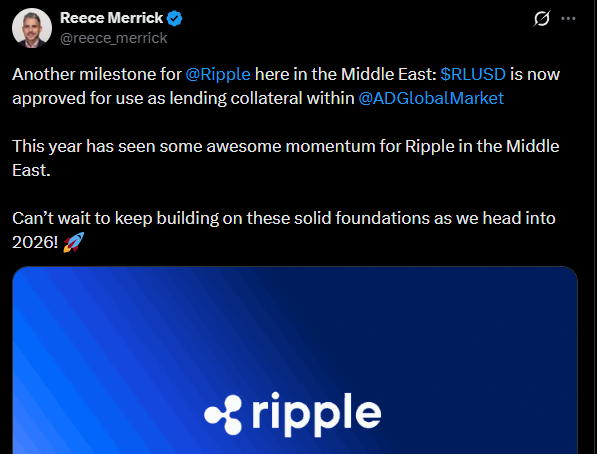
The post signals how quickly Ripple's stablecoin strategy is accelerating, especially in major economic hubs across the Gulf. Institutions are increasingly looking for reliable, regulated USD-backed assets that can support international payments and compliance-ready collateral systems - areas where Ripple is positioning RLUSD as a strong competitor.
Ripple's Expanding Footprint in the UAE
The approval inside ADGM adds to a long list of regulatory steps Ripple has taken across the UAE. The company has been steadily building its presence since late 2024, with a strategy focused on integrating digital-asset infrastructure into the region's financial hubs. Ripple disclosed in October 2024 that it was pursuing a license from the Dubai Financial Services Authority (DFSA), which regulates activity inside the Dubai International Financial Centre (DIFC). Ripple secured in-principle approval that same month, followed by full approval in March.
This clearance allowed Ripple to offer cross-border crypto payment solutions within the DIFC - a zone that runs its own financial ecosystem, independent of broader UAE regulations. The momentum continued when the DFSA approved RLUSD in June for use by companies operating inside the DIFC. This enabled institutions to use the stablecoin in regulated activities like payments, settlement systems, and treasury workflows. For a stablecoin introduced only months earlier, adoption across two of the UAE's major free economic zones is a strong signal of regional trust.
Ripple has also secured early partners in the region. Zand Bank - a fully digital bank - and fintech app Mamo have joined Ripple Payments and will become among the first institutions in the UAE to plug into the network. These partnerships underline that Ripple is not only receiving regulatory approval but also building commercial integrations at the same time.
Understanding RLUSD and Its Regulatory Foundations

RLUSD launched in late 2024 under a limited-purpose trust charter from the New York Department of Financial Services (NYDFS), one of the world's strictest digital-asset regulators. The stablecoin is pegged 1:1 to the U.S. dollar and fully backed by cash and equivalents, aligning with global calls for transparent and regulated stablecoin models.
Its approval in Abu Dhabi signals how regulators view Ripple's approach to risk management. The FSRA's recognition often requires clear standards relating to reserve assets, balance sheet risk, and redemption processes. Stablecoins that meet those requirements generally qualify for institutional use inside the ADGM financial zone.
The Middle East has become a critical region for Ripple's long-term plans. The UAE is home to numerous financial institutions seeking compliant pathways into digital assets, which makes RLUSD especially attractive for treasury operations, corporate settlements, and institutional lending.
A Broader Regulatory Shift: UAE Brings DeFi and Web3 Under Central Bank Oversight
Ripple's approval also arrives during a significant turning point for the UAE's digital-asset environment. Earlier this week, the nation enacted a new central bank law that extends oversight across decentralized finance, stablecoins, Web3 platforms, and exchanges.
Federal Decree Law No. 6 of 2025 - which has been in force since September 2025 - introduces a licensing requirement for almost all digital-asset services tied to payments, lending, custody, trading, or investment. Companies must secure a license from the Central Bank of the UAE by September 2026. This move establishes a nationwide framework that complements Dubai's DIFC and Abu Dhabi's ADGM, creating a unified system where stablecoins like RLUSD fit into regulated financial environments rather than operating in isolated zones.
For Ripple, this timing may prove beneficial. RLUSD's early regulatory approvals put it in a strong position as institutions begin aligning with the new central-bank requirements. Markets across the UAE often reward assets and platforms that secure compliance before deadlines, especially when financial institutions seek low-risk stablecoin solutions.
Looking Ahead: What This Means for Ripple in 2026 and Beyond
Ripple's long-term strategy in the Gulf appears clear: establish RLUSD as a fully regulated, institution-ready stablecoin across the UAE and surrounding financial hubs. The company is already gaining momentum among regional banks and fintech firms, while regulators continue to build frameworks that encourage licensed stablecoin activity.
The approval inside ADGM, combined with the recent central bank law, sets the stage for wider integration of regulated digital assets across payments, lending, and cross-border finance. Ripple's leadership has already signaled that 2026 will be a year of expansion, especially as institutions begin adjusting to the new national licensing system.
With approvals rolling in from multiple regulators, growing partnerships, and rising stablecoin adoption, RLUSD is positioned to play a significant role in the region's shift toward regulated digital finance.


