

Summary:
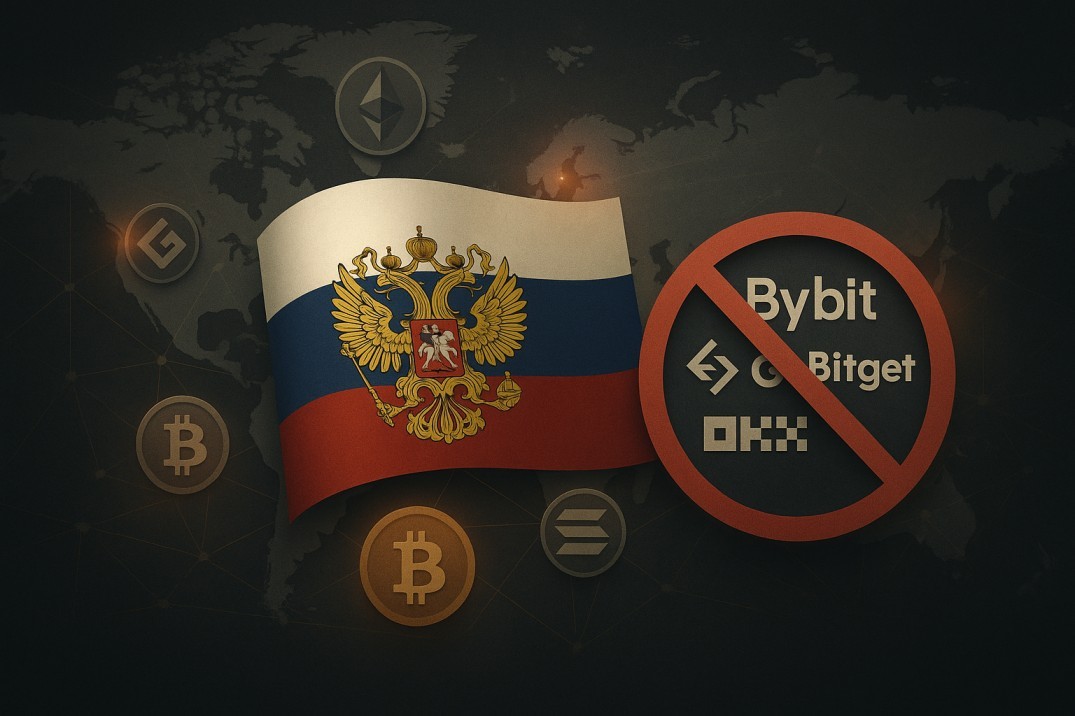
- Belarus blocked Bybit, OKX, Bitget, Gate, BingX and Weex, citing "inappropriate advertising."
- The move came hours after Russia signaled it may relax crypto access rules for a small group of wealthy, "qualified investors."
- Russia's tightening of the gray market and Belarus's crackdown appear to move in parallel, showing the region's shifting crypto strategy.
- New rules could create two separate user classes: one with access to regulated crypto channels, another pushed toward offshore platforms.
Belarus took a direct step on Thursday by restricting access to several major crypto exchange domains. The Ministry of Information said it had blocked Bybit, OKX, Bitget, Gate, BingX and Weex, linking the action to "inappropriate advertising" under Article 511 of the Law on Mass Media.
The announcement short, formal and aimed at the domain level rather than user accounts. But its timing matters. Belarus usually aligns with Russian regulatory attitudes, especially on digital finance. Seeing such a sweeping block drop on the exact day Russia hinted at changes to its own crypto stance raises questions about coordination, timing and strategy.
For users in Belarus, the impact is immediate: the global versions of these exchanges are simply no longer reachable through normal means. It doesn't target crypto ownership itself - only the platforms. But by targeting the main gateways, the government is making it clear that it wants tighter control over how people interact with digital assets.
Russia Sends Its Own Signal
While Belarus was blocking access, Russia's Central Bank was outlining a different direction - a controlled opening for a very specific class of participants.
Vladimir Chistyukhin, first deputy chairman at the Central Bank of Russia, told state-backed outlet RIA Novosti that it "agreed to allow qualified investors" into the crypto market. The comment is in line with earlier stories that regulators were considering giving certain users more room to operate, partly in response to sanctions that have cut the country off from global finance.
This is not a broad invitation. It builds on late-April proposals that crypto access would be restricted to "super-qualified investors," which require either: Over 100 million rubles (about $1.2 million) in total wealth, or An annual income of at least 50 million rubles (around $630,000).
These thresholds push most of the population out of the regulated market. The plan essentially creates a high-net-worth zone where wealthy individuals can legally interact with crypto under Moscow's supervision.
Source: RIA Novosti
Parallel Moves, Shared Pressure
When two allied governments take synchronized steps - one restricting access, the other narrowing who can participate - the connection is hard to ignore. Both countries face the same macro pressure: sanctions, the shrinking availability of traditional financial rails, and the rise of informal cross-border payments.
For Russia, crypto can act like a pressure valve, but only for people with enough wealth to pass strict eligibility checks. For Belarus, which leans heavily on Russia's political and economic orbit, restricting access to global exchanges may operate as a form of alignment.
Neither country is banning crypto outright. They are reshaping the categories of people who can access it. That's what makes this moment important: it shows that digital-asset governance in the region is now more about segmentation than prohibition.
Why Exchanges Matter in This Context
Bybit, OKX, Bitget, Gate, BingX and Weex aren't small names. They are among the major platforms used by retail traders across Europe, Asia and the CIS region. Cutting access to every one of them simultaneously is not random.
The six exchanges provide:
- Easy onboarding
- Deep liquidity
- Multiple fiat gateways
- Direct access to major assets without local intermediaries
When a government wants tighter oversight, these exact features become the problem. Belarus framing the issue as "inappropriate advertising" is a legal mechanism, but the real motive is likely broader: controlling entry points.
Crypto advertising is one of the easiest legal levers a regulator can pull. It doesn't require banning the activity itself - only the channels that promote it. And for Belarus, this method avoids a confrontation with users while cutting off the biggest platforms.
Russia's Qualified-Investor Model Explained Simply
The "qualified investor" idea is not new - traditional markets have used it for decades. The concept assumes that wealthy individuals can tolerate more risk and have access to better financial advice.
Russia seems to be adopting this model for crypto by:
- Keeping retail users away from volatile assets
- Granting limited access to individuals who meet wealth or income thresholds
- Reducing the gray areas that allow unregulated activity
In practice, it means the Central Bank can say it is allowing crypto adoption while keeping the majority of the population away from it. This strategy also ensures that crypto activity runs through institutions the state can supervise.
International Pressure Behind the Scenes
Russia is under one of the most complex sanction regimes in modern history. Its access to global banking rails has weakened, and alternative digital networks have gained importance for cross-border trade.
Crypto plays a role here, but Moscow wants that role to be traceable and compliant with its domestic frameworks. It wants fewer surprises, fewer informal routes, and a tighter circle of participants.
Belarus's domain blocks fit neatly into that ecosystem. They reduce the number of entry points that aren't controlled or monitored locally. For governments coordinating quietly, alignment is sometimes expressed through small administrative decisions rather than sweeping new laws.
Closing Thoughts
Crypto policy in Eastern Europe is shifting again, but not in a single direction. Belarus is restricting; Russia is refining. Both seem to be building new boundaries around who can participate in digital-asset activity and how These steps also show a shared preference for control over prohibition. Instead of banning crypto, both countries are shaping it through access rules - limiting some users, enabling others, and enforcing where the lines are drawn.
As sanctions, political pressure and financial restructuring continue to reshape the region, crypto will remain part of that equation. But the pathways to participate are becoming narrower, stratified and more closely managed than before.
READ MORE : What is COTI V2: Revolutionizing Blockchain Privacy with Garbled Circuits